What is a daily standup meeting? Definition, format, questions and examples
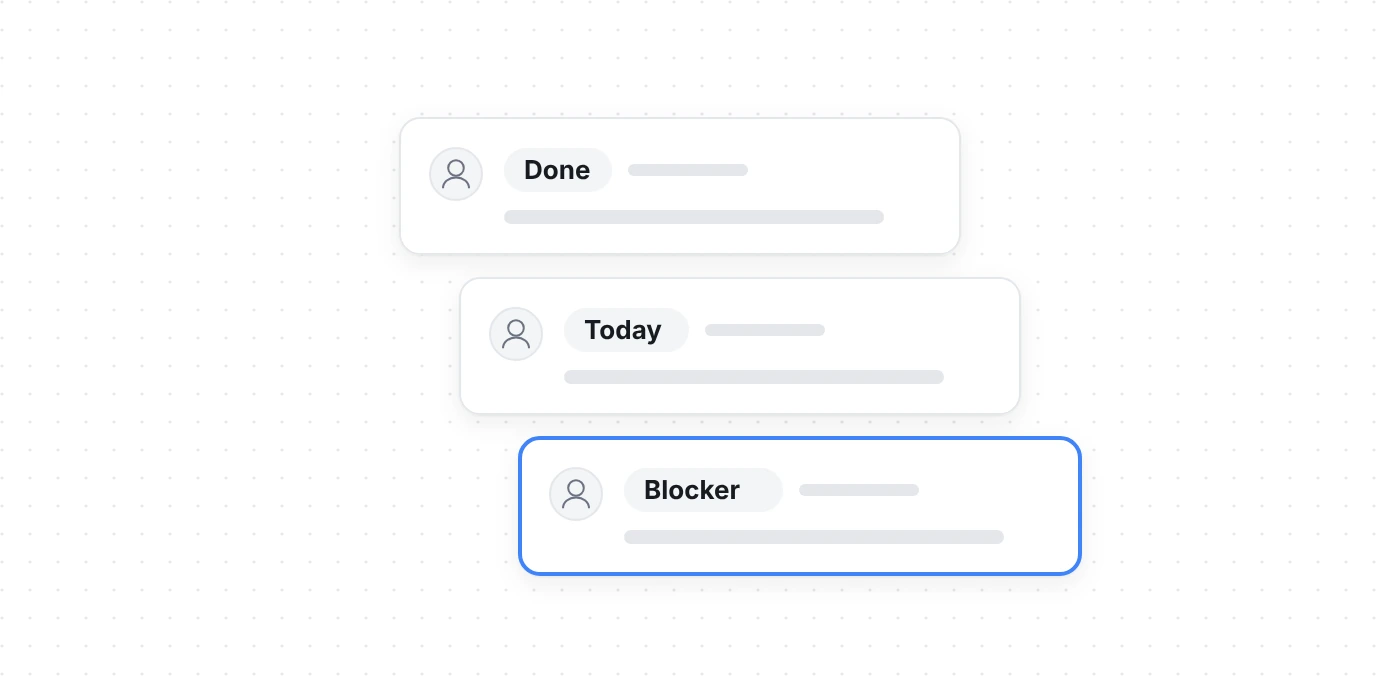
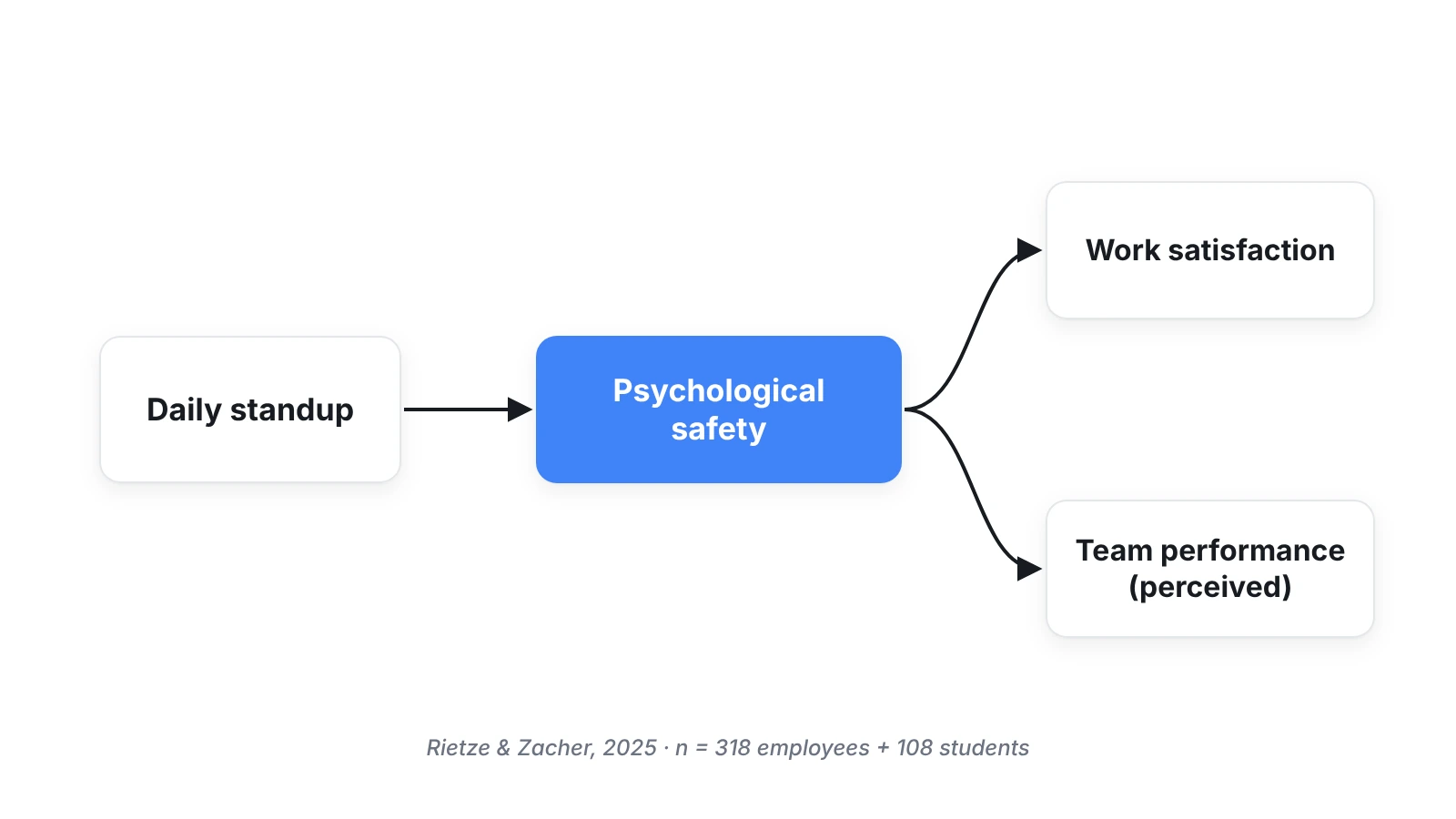
A daily standup meeting is a short check-in, usually 15 minutes or less, where a team shares what moved forward, what comes next and what is blocking progress. It is the most widely used agile teamwork practice, and in 2025 researchers linked it to psychological safety: teams that hold standups report more psychological safety, and that safety is linked to higher satisfaction and better perceived team performance.
A year later, a 2026 study of software practitioners found that 76.4% feel less productive on days packed with meetings. Both findings are true at once. A standup helps when it builds trust and coordination, and it hurts when it becomes one more meeting that breaks the day. This guide covers what a standup is, what the current research says, the format and questions to use, and where the evidence pushes back.
What a daily standup is and what it is for
A daily standup is a brief team meeting held at the same time every working day to check progress toward a shared goal and adjust the plan for the next 24 hours. Teams also call it a daily stand-up, a daily huddle, a daily check-in or, in Scrum, the Daily Scrum.
The name comes from the habit of holding it on your feet. If people stand, the meeting stays short. That idea has evidence behind it: in a controlled study of 111 five-person groups, seated meetings ran 34% longer than standing ones and produced no better decisions. Most remote teams sit today, or skip the call entirely, but the name stuck.
The practice comes from agile software development. The Scrum Guide, still the reference version in 2026, defines the Daily Scrum as “a 15-minute event for the Developers of the Scrum Team” whose purpose is “to inspect progress toward the Sprint Goal and adapt the Sprint Backlog as necessary.”
A good standup does three jobs:
- Alignment. Everyone knows what teammates are working on and how it connects to the team goal.
- Early warning. Blockers and risks come out the same day, not at the end of the sprint.
- Daily planning. The team agrees on what happens next, and who needs to talk to whom after the meeting.
A standup is not a status report for a manager, a problem-solving session or a ticket-by-ticket review. Those belong in follow-up conversations.
What the research says in 2026
The strongest recent evidence comes from Sarah Rietze and Hannes Zacher at Leipzig University. In 2025 they ran two studies: a two-wave survey of 318 employees working in agile teams, and an intervention with student teams where 58 people started holding standups and 50 did not. In both, standups were directly linked to psychological safety, the belief that it is safe to take interpersonal risks in the team. Through that safety, standups were indirectly linked to work satisfaction and team performance perceptions.
That mechanism matches what earlier field research found inside real teams. Viktoria Stray and colleagues observed 79 standups and interviewed 60 people across 12 software teams in Malaysia, Norway, Poland and the UK. People valued standups for “information sharing with the team and the opportunity to discuss and solve problems.” They disliked them when the meeting turned into “status reporting to the manager,” or when it felt too frequent and too long.
Put together, the research points to one rule: a standup earns its place when it makes it easier to speak up and coordinate, not when it collects status.
The standard format and the questions teams use
Most standups follow the same simple format. Adjust it to your team, but keep the constraints: short, daily, focused on the plan.
| Element | Typical setup |
|---|---|
| Duration | 15 minutes or less (how long a standup should be) |
| Frequency | Every working day, same time |
| Who attends | The people doing the work; managers listen, they do not run it |
| Who facilitates | A rotating team member, Scrum Master or team lead |
| Structure | One to two minutes per person, then blockers noted with owners |
| Output | A plan for today and a short list of blockers with owners |
The classic version uses three questions, and Atlassian still uses them to give the meeting structure:
- What did I work on yesterday?
- What am I working on today?
- What is blocking me?
The 2020 Scrum Guide no longer prescribes them. Teams “can select whatever structure and techniques they want,” as long as the meeting focuses on the Sprint Goal and produces a plan for the next day. Many teams now use goal-focused versions:
- What did I move forward toward our goal since the last standup?
- What will I finish today, and what does done look like?
- Is anything slowing me down or at risk of slipping?
- Who do I need to talk to today?
The quality of each update matters more than the questions. Here is the same day reported two ways.
Vague: Yesterday: worked on the checkout stuff. Today: more checkout. Blockers: none.
Useful: Yesterday: shipped the new address form to staging; QA found two validation bugs. Today: fix both and get the PR reviewed by noon. Blocker: I need the updated tax rules from Finance before I can close the ticket. Ana, can we talk for ten minutes after standup?
The useful update names a result, a finish line for today and a blocker with an owner and a next step. If you want the difference between this and the Scrum version spelled out, read Daily Scrum vs daily standup.
Where the evidence pushes back
Standups are popular, but not universally liked. In a survey of 221 developers, 87% of those using agile methods held daily standups. Among people who attended, 44.7% rated them positively and 36.6% negatively. Teams of 12 or more people were the most negative. The authors note the sample came from Reddit, so it may lean toward people with strong opinions.
The 2026 data adds a second warning. In the Patkar et al. study, 61.8% of practitioners reported at least moderate disruption to their flow on high-meeting days, and the top frustrations were unclear purpose and excessive duration. The authors treat their findings as hypotheses that still need larger samples, but the pattern is consistent with Microsoft’s June 2025 telemetry, which found people are interrupted every two minutes during core hours by meetings, email or chat.
The honest reading: the standup itself is not the problem. Size, purpose and timing are. A 15-person status round at 10 a.m. is a different practice from a five-person coordination check, even if both are called a standup. We look at this trade-off in depth in Are daily standups worth it? and the most common failure point in Standup blockers.
How we think about live and async standups
The research gives a clear target: keep the trust-building and coordination, cut the interruption. For most teams that means choosing the format on purpose.
| Live standup | Async standup | |
|---|---|---|
| Best for | Same-timezone teams that collaborate closely | Remote, hybrid or multi-timezone teams |
| Time cost | Everyone blocks the same 15 minutes | Each person writes for a few minutes |
| Record | Lost unless someone takes notes | Searchable history of every update |
| Blockers | Raised out loud, easy to forget | Written down and easy to follow up |
| Team size | Slows down past 8 to 10 people | Works across larger and multiple teams |
Many teams combine both: written updates on most days and one short live call a week for planning and connection. If your team spans several time zones, see how to run standups across time zones. If you want to drop the meeting entirely, see seven daily standup alternatives.
Dailybot runs the async version inside Slack, Microsoft Teams, Google Chat and Discord. It sends the questions at the start of each person’s day in their own time zone, follows up with anyone who has not answered, flags blockers and posts one compiled report to the channel you choose. The Starter plan is free for unlimited members and includes the daily standup features.
Start a free async standup in Slack or Teams
Frequently asked questions
What is the purpose of a daily standup? To align the team on the plan for the day, check progress toward a shared goal and surface blockers early. Recent research also links standups to psychological safety in the team.
How long should a daily standup be? Fifteen minutes or less. The Scrum Guide timeboxes the Daily Scrum at 15 minutes, and field observations put the average standup at around 12 minutes.
What are the three standup questions? What did I do yesterday, what will I do today and what is blocking me. The current Scrum Guide does not require them, and many teams now use goal-focused versions.
Who should attend a daily standup? The people doing the work. Managers and stakeholders can listen, but the team should run it.
Is a daily standup the same as a Daily Scrum? Almost. The Daily Scrum is the Scrum-specific version with fixed rules; standup is the general term any team uses.
Can a daily standup be async? Yes. Async standups collect the same updates in writing through Slack, Teams or another chat tool, which works well for distributed teams. See standups for non-engineering teams for formats outside software.