Daily Scrum vs daily standup: rules, the 15-minute timebox and when to go async
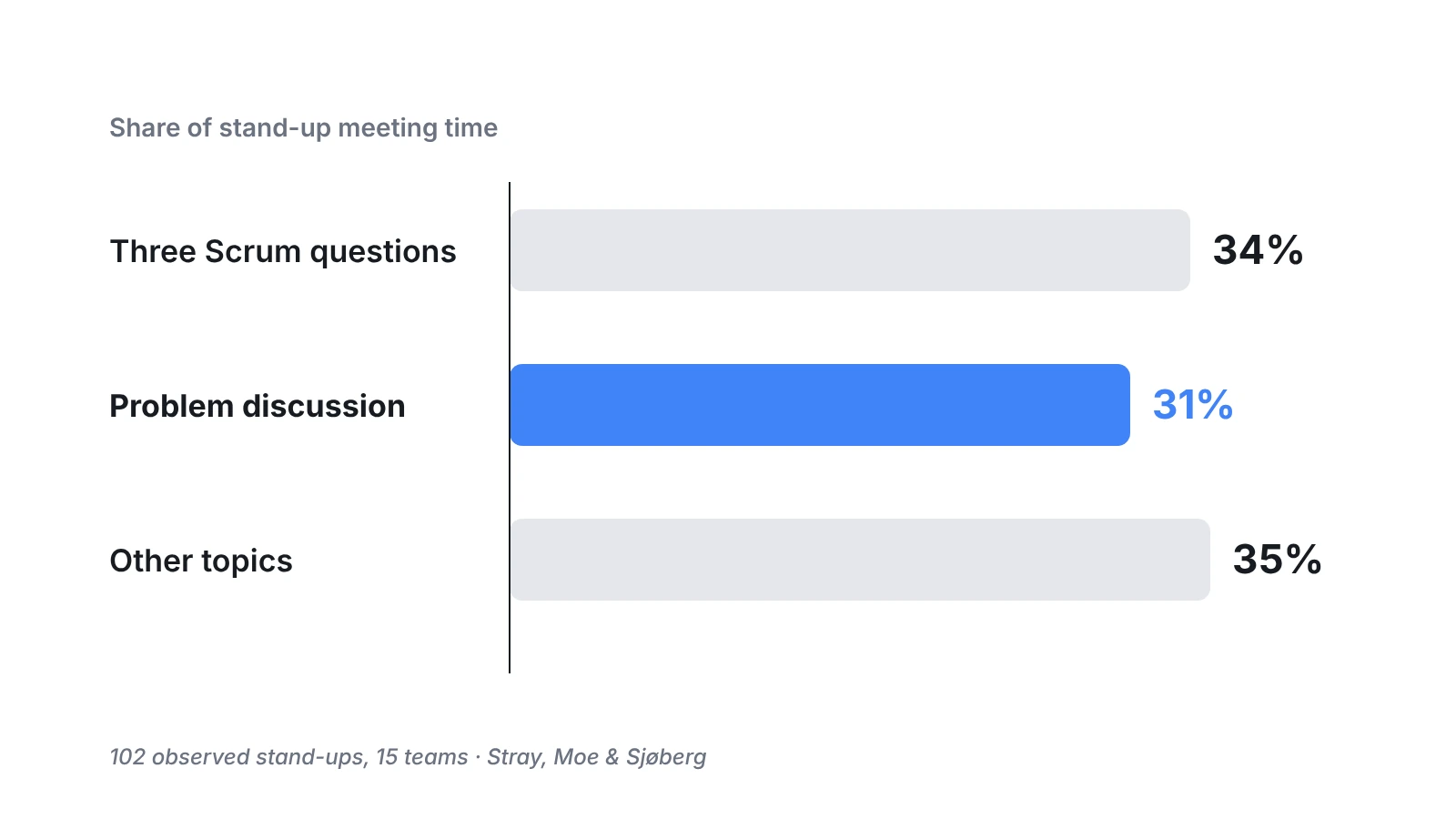
Most teams still open their Daily Scrum with three questions: what I did yesterday, what I will do today, what is blocking me. The Scrum Guide stopped requiring those questions in its 2020 revision, and that version is still the reference in 2026. When researchers recorded real stand-ups, they found only 34% of meeting time went to the three questions, while 31% went to discussing problems.
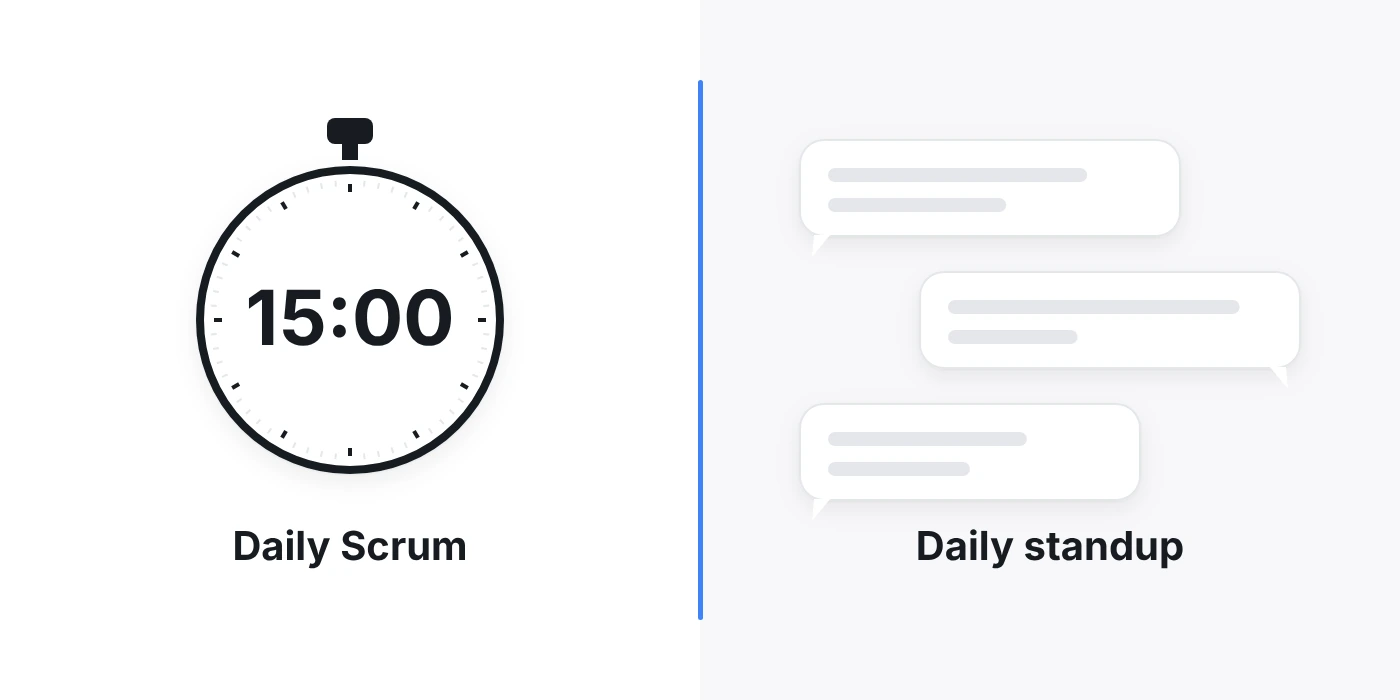
So the names “Daily Scrum” and “daily standup” are used as synonyms, but they describe two different things: one is a defined event with rules, the other is a team habit that every team shapes its own way. This piece separates the two, shows what the evidence says about each, and covers when moving the meeting to an async format helps and when it costs you.
One is a rule and the other is a habit
The short answer: every Daily Scrum is a standup, but not every standup is a Daily Scrum.
| Daily Scrum | Daily standup | |
|---|---|---|
| Defined by | The Scrum Guide | Common practice, no single rulebook |
| Timebox | 15 minutes, fixed | Usually 15 minutes, flexible |
| Who attends | The Developers of the Scrum Team | The whole team, any function |
| Focus | Progress toward the Sprint Goal | Progress, plans and blockers |
| Structure | Any structure the Developers choose | Often the three classic questions |
| Output | An actionable plan for the next day of work | Shared awareness and a list of blockers |
If your team runs Scrum, the Daily Scrum has a specific job. If it does not, a standup is simply a short daily coordination ritual, and you can design it around your own goals. For the general definition and format, start with what a daily standup meeting is.
What the Scrum Guide requires in 2026
The current Scrum Guide is short on rules for this event, and each one matters:
- Purpose. “To inspect progress toward the Sprint Goal and adapt the Sprint Backlog as necessary, adjusting the upcoming planned work.”
- Timebox. “A 15-minute event for the Developers of the Scrum Team.”
- Attendees. The Developers. If the Product Owner or Scrum Master are actively working on items in the Sprint Backlog, they take part as Developers.
- Consistency. It is held “at the same time and place every working day of the Sprint” to reduce complexity.
- Format. “The Developers can select whatever structure and techniques they want,” as long as the meeting focuses on the Sprint Goal and produces an actionable plan for the next day.
Two things are missing that many teams assume are required. The three questions are gone: the 2017 Guide listed them as an example, and the 2020 Guide removed them. And the Guide does not say the meeting has to be held in person or standing up. A team that writes its Daily Scrum in a shared channel at a fixed time can still meet the purpose.
What happens in real daily scrums
The rules describe the event. Field studies describe what teams do with it.
Viktoria Stray, Nils Brede Moe and Dag Sjøberg observed 102 stand-ups and interviewed 60 members of 15 teams in four companies between 2010 and 2018, with findings published in IEEE Software. The average meeting lasted 11.7 minutes, with a range from 4 to 24. Only 34% of the time went to the three questions; 31% went to discussing problems. Their recommendations break with the classic script: drop the “what did you do yesterday” question, share the facilitation, consider meeting right before lunch, and stop meeting daily if three or four times a week is enough.
The 2025 evidence explains why that problem time matters. In a survey of 318 employees in agile teams and an intervention study with 108 students, Rietze and Zacher found that holding daily stand-ups is linked to higher psychological safety, and through it to work satisfaction and perceived team performance. A Daily Scrum that leaves room to raise a problem does more than one that only collects updates.
When to go async and the case against it
Distributed teams are the main reason to move the Daily Scrum out of a call. Microsoft’s June 2025 data shows that nearly a third of meetings now span multiple time zones and that meetings after 8 p.m. grew 16% year over year. For a team spread from Bogotá to Madrid, a fixed 15-minute call always lands badly for someone. Writing the update at the start of each person’s day keeps the purpose and drops the scheduling problem. We cover the scheduling side in standups across time zones.
The strongest argument against going fully async comes from a study of 61,182 Microsoft employees during the first six months of 2020. When the whole company went remote, collaboration networks became “more static and siloed,” synchronous communication dropped, asynchronous communication rose, and the authors concluded this may make it harder to acquire and share new information across the network. That study looked at remote work in general, not stand-ups specifically, but the warning applies: if every interaction becomes written and asynchronous, teams lose some of the cross-team conversation that live meetings create.
The practical middle ground for most Scrum teams:
- Run the Daily Scrum async on most days, with a fixed response time so it still happens “at the same time every working day.”
- Keep the focus on the Sprint Goal: one question about progress toward it, one about today’s plan, one about risks.
- Hold a short live Daily Scrum once or twice a week, especially near the start and end of the sprint.
- Move any problem that needs discussion into a call with only the people involved, the same day.
How we handle it at Dailybot
We treat the Scrum Guide’s purpose as the non-negotiable part and the format as a team decision. The evidence supports that split: the value of the meeting comes from coordination and the safety to raise problems, not from the three questions or from standing in a circle.
Dailybot runs async Daily Scrums in Slack, Microsoft Teams, Google Chat and Discord. Each Developer gets the prompt at the start of their own day, reminders go to anyone who has not answered, blockers are flagged, and one compiled report lands in the team channel. Teams that want a live sync keep it for the days it matters most. The Starter plan is free for unlimited members.
Set up an async Daily Scrum for free
Frequently asked questions
Is a daily standup the same as a Daily Scrum? In everyday use, yes. Formally, the Daily Scrum is the Scrum event with a fixed purpose and timebox; standup is the general name any team uses.
Does the Daily Scrum still use the three questions? Not officially. They appeared in the 2017 Scrum Guide as an example and were removed in 2020. Teams can still use them if they help.
Can the Product Owner attend the Daily Scrum? The Daily Scrum is for the Developers. The Product Owner or Scrum Master take part as Developers only when they are working on Sprint Backlog items.
Can a Daily Scrum be async? The Scrum Guide does not require a live meeting. An async Daily Scrum works if it keeps the Sprint Goal focus and produces a plan for the day.
What happens if the Daily Scrum runs over 15 minutes? The timebox is fixed. Move the discussion that is running long into a follow-up with only the people involved. See how long a daily standup should be.