How long should a daily standup be? Timebox, agenda and common mistakes
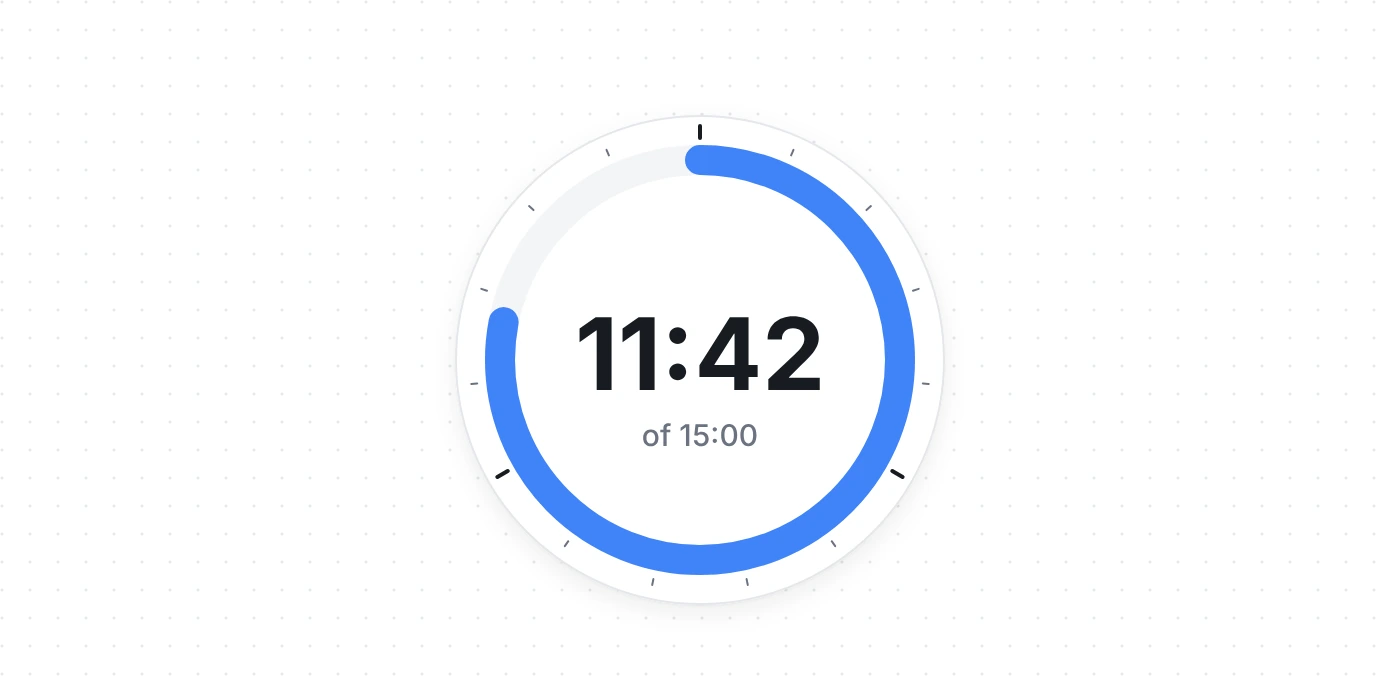
A daily standup should take 15 minutes or less. That is the timebox in the Scrum Guide, and it matches what researchers see in practice: across 102 observed stand-ups in 15 teams, the average meeting lasted 11.7 minutes, with the shortest at 4 and the longest at 24.
The harder question is not the number on the clock. In a 2026 survey of software practitioners, “excessive duration” ranked among the top two frustrations with meetings, next to unclear purpose. A standup that drifts from 15 to 25 minutes every day costs a ten-person team more than eight hours of combined time each week. Here is how to keep it short without cutting the part that makes it useful.
Fifteen minutes is a ceiling, not a target
The Scrum Guide sets the Daily Scrum at 15 minutes regardless of team size. Atlassian gives the same advice for any stand-up meeting. Neither says a standup should fill all 15.
The original reason for standing up was speed, and it holds up in experiments. In a controlled study with 56 standing and 55 seated five-person groups, seated meetings ran 34% longer and produced no better decisions. The study used short, well-defined tasks, so it says more about focus than about posture: a format that discourages lingering keeps meetings short without hurting outcomes.
The cost of running long is larger today than when those studies were done. Microsoft’s June 2025 telemetry shows half of all meetings fall in the hours people are most productive, 9 to 11 a.m. and 1 to 3 p.m., and that workers are interrupted every two minutes during core hours. Every extra minute of standup lands inside that window.
A 15-minute agenda that holds
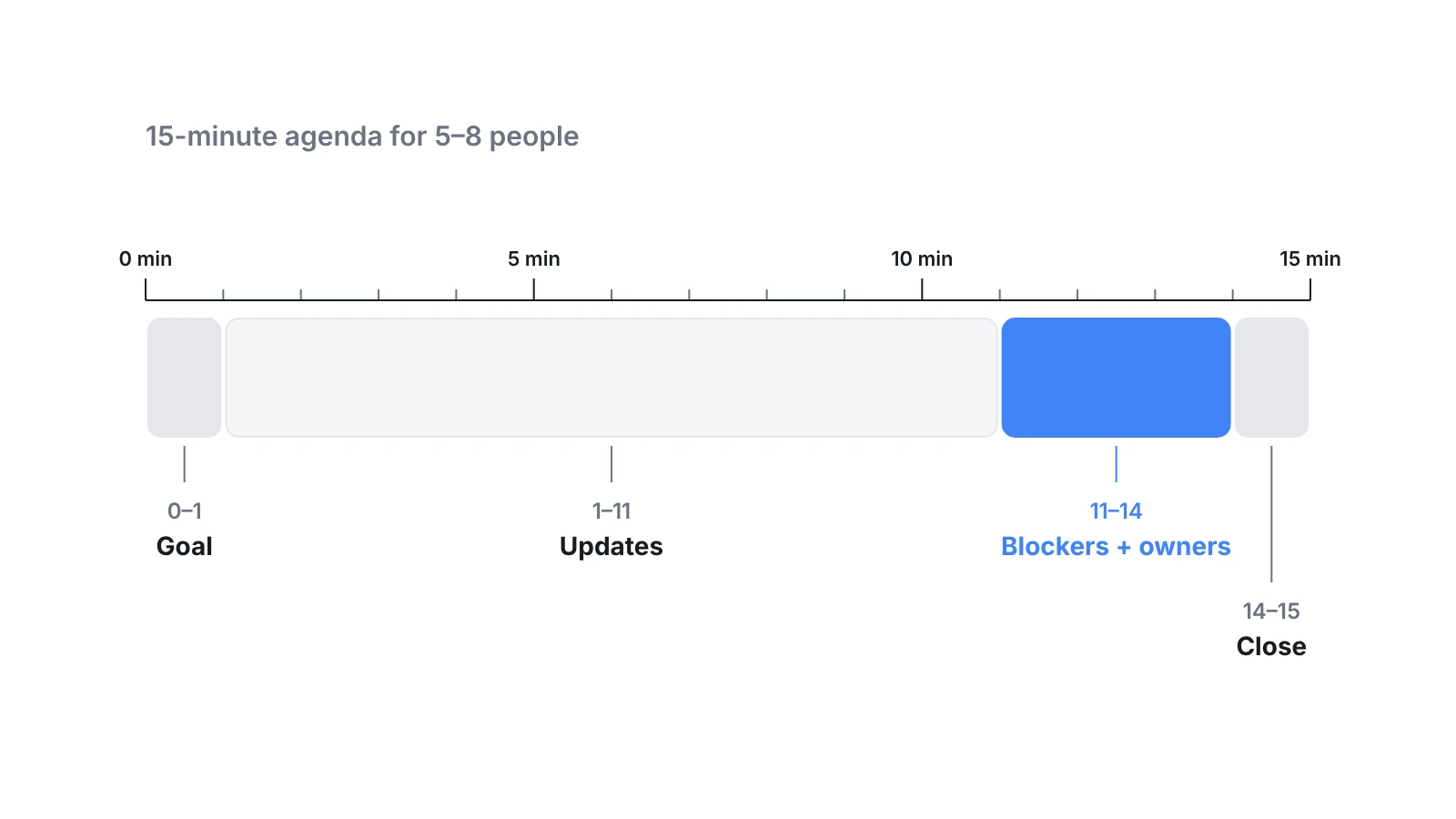
A simple rule of thumb in our experience: about one to two minutes per person, plus three minutes for blockers. That math is also why large standups struggle. In a survey of 221 developers, teams of 12 or more were the most negative about their standups.
| Minute | What happens |
|---|---|
| 0:00 to 0:01 | Facilitator opens and shows the sprint or weekly goal |
| 0:01 to 0:11 | Each person gives a one to two minute update |
| 0:11 to 0:14 | Facilitator reads back blockers and names an owner for each |
| 0:14 to 0:15 | Close; the people who need a follow-up stay on |
If the team has more than eight or nine people, you have three options: split into smaller standups by workstream, walk the task board instead of going person by person, or collect updates in writing and keep the live time for blockers only.
The mistakes that make standups run long
| Mistake | What it looks like | Fix |
|---|---|---|
| Problem-solving in the room | Two people debug while eight wait | Name the topic and the pair, solve it right after |
| Reporting to the manager | Everyone faces the lead and recites tasks | Rotate the facilitator; talk to the team, not the boss |
| Late start | The meeting waits for the last person | Start on time, every time |
| Too many people | 15 updates at two minutes each | Split by workstream or go async |
| No visible goal | Updates drift into unrelated work | Open with the goal on screen |
| Activity lists | “I had meetings and answered emails” | Report results and today’s finish line |
Status reporting to the manager is the one researchers flag most often. In a study of 12 teams, it was one of the main reasons people disliked their standups, together with meetings that felt too frequent and too long.
The case for letting it run a little longer
A strict timebox has a cost, and the evidence is clear about it. In the same studies that found people dislike long standups, the part they valued most was the “opportunity to discuss and solve problems”. In the observed meetings, problem discussion took 31% of the time.
The 2025 research points the same way. Rietze and Zacher found standups are linked to psychological safety, and through it to satisfaction and perceived team performance. If a hard stop at 15 minutes means nobody ever raises the awkward problem, the meeting gets shorter and loses the reason it exists.
There is also a limit to the standing-meeting evidence. Bluedorn and colleagues tested short, structured tasks; their results do not show that cutting a complex discussion short leads to equally good decisions.
Our take: protect the time, move the problem-solving
We keep the standup short and move the discussion, not the problem. The standup is where a problem gets named and gets an owner; the conversation happens right after, with only the people who need to be there. That keeps the meeting under 15 minutes and keeps the space to speak up.
For teams that cannot get under 15 minutes live, writing the updates is the fastest fix. With Dailybot, each person answers in Slack, Microsoft Teams, Google Chat or Discord at the start of their day, and the team reads one compiled report with blockers highlighted. The live call, if you keep one, can then be only about blockers. For more on what to do with blockers, read Standup blockers. For the bigger picture, see what a daily standup meeting is.
Try a written standup for free
Frequently asked questions
How long should a daily standup be? Fifteen minutes or less. Observed standups average around 12 minutes.
How long should each person talk? About one to two minutes. If updates take longer, the questions are too broad or the person is solving problems in the meeting.
What if the team is too big for 15 minutes? Split by workstream, walk the board instead of going person by person, or move updates to writing and keep live time for blockers.
Is it bad if the standup runs over sometimes? Not if the extra time is a real problem being raised. Move the discussion to a follow-up so the rest of the team can leave.
Do standups have to be held standing? No. Standing helps keep meetings short, but the timebox and the focus matter more than posture.