Are daily standups worth it? When they work, when they don't and what to do instead
Two recent studies seem to disagree about daily standups. In 2025, Rietze and Zacher showed that holding daily standups is linked to higher psychological safety, and through it to more work satisfaction and better perceived team performance. In 2026, Patkar and colleagues found that 76.4% of software practitioners feel less productive on high-meeting days, and that unclear purpose and excessive duration top the list of meeting frustrations.
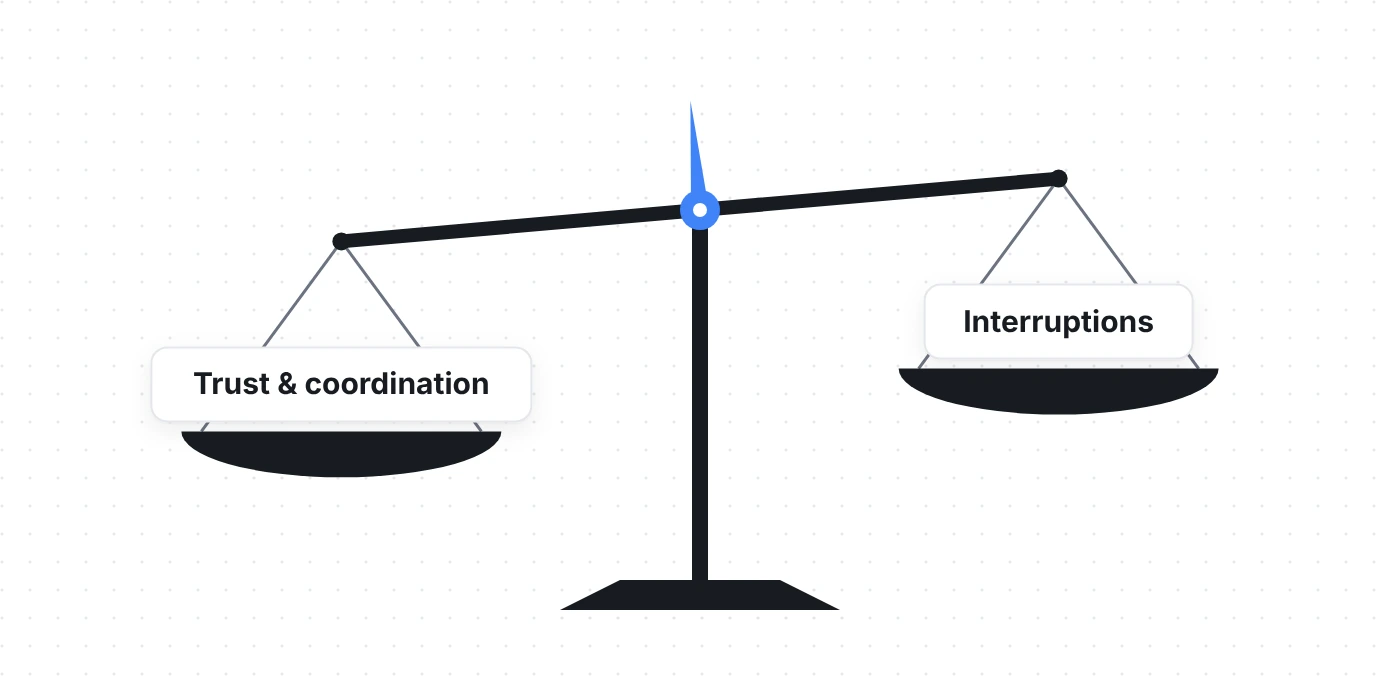
Both can be true. A standup can be the meeting that builds trust in a team and also one more interruption in a crowded day. Whether it is worth it depends on the size of the team, the purpose of the meeting and the format. This piece lays out the case for, the case against, the conditions that decide it and what to do when your standup is not working.
The case for daily standups
The strongest evidence for standups is recent. Rietze and Zacher ran two studies: a two-wave survey of 318 employees in agile teams, and an intervention where 58 students in teams started holding standups and 50 did not. In both, standups were directly and positively related to psychological safety, and indirectly to satisfaction and team performance perceptions. The authors conclude their findings “highlight the overall value of conducting DSM in teams.”
Field research inside companies explains where that value comes from. After observing 79 standups across 12 teams, Stray and colleagues found people valued them for “information sharing with the team and the opportunity to discuss and solve problems”.
And standups are not a niche practice. In a survey of 221 developers, 87% of those using agile methods held them, and people who attended rated their value higher than those who did not: 3.1 versus 2.3 on a five-point scale.
The case against daily standups
The same survey shows a split. Among people who attend standups, 44.7% were positive and 36.6% negative, and teams of 12 or more were the most negative. The sample came from Reddit, which may favor strong opinions, but the split is large.
The cost side has grown since then. Microsoft’s June 2025 data shows workers are interrupted every two minutes during core hours, and half of all meetings land in the most productive hours of the day, 9 to 11 a.m. and 1 to 3 p.m. A daily standup at 10 a.m. sits right in that window.
There is also evidence that fewer meetings, not better meetings, can be the bigger win. Laker and colleagues surveyed 76 companies, each with more than 1,000 employees, that introduced between one and five meeting-free days a week. Employees reported more autonomy and cooperation and less stress and micromanagement, with the best results at three meeting-free days. Those results come from pulse surveys without a control group, so treat them as a direction, not a measured effect.
When standups work and when they don’t
Reading the evidence together, the standup is not the deciding factor. The conditions are.
| Condition | Standups tend to work | Standups tend to fail |
|---|---|---|
| Team size | 3 to 9 people working on one goal | 12 or more, or several unrelated workstreams |
| Purpose | Coordination and raising problems | Status reporting to a manager |
| Duration | Under 15 minutes, discussions moved after | 20 minutes or more, problem-solving in the room |
| Timing | Same time zone, a slot outside deep-work hours | Across time zones, or in the middle of focus time |
| Follow-up | Every blocker gets an owner | Blockers are noted and forgotten |
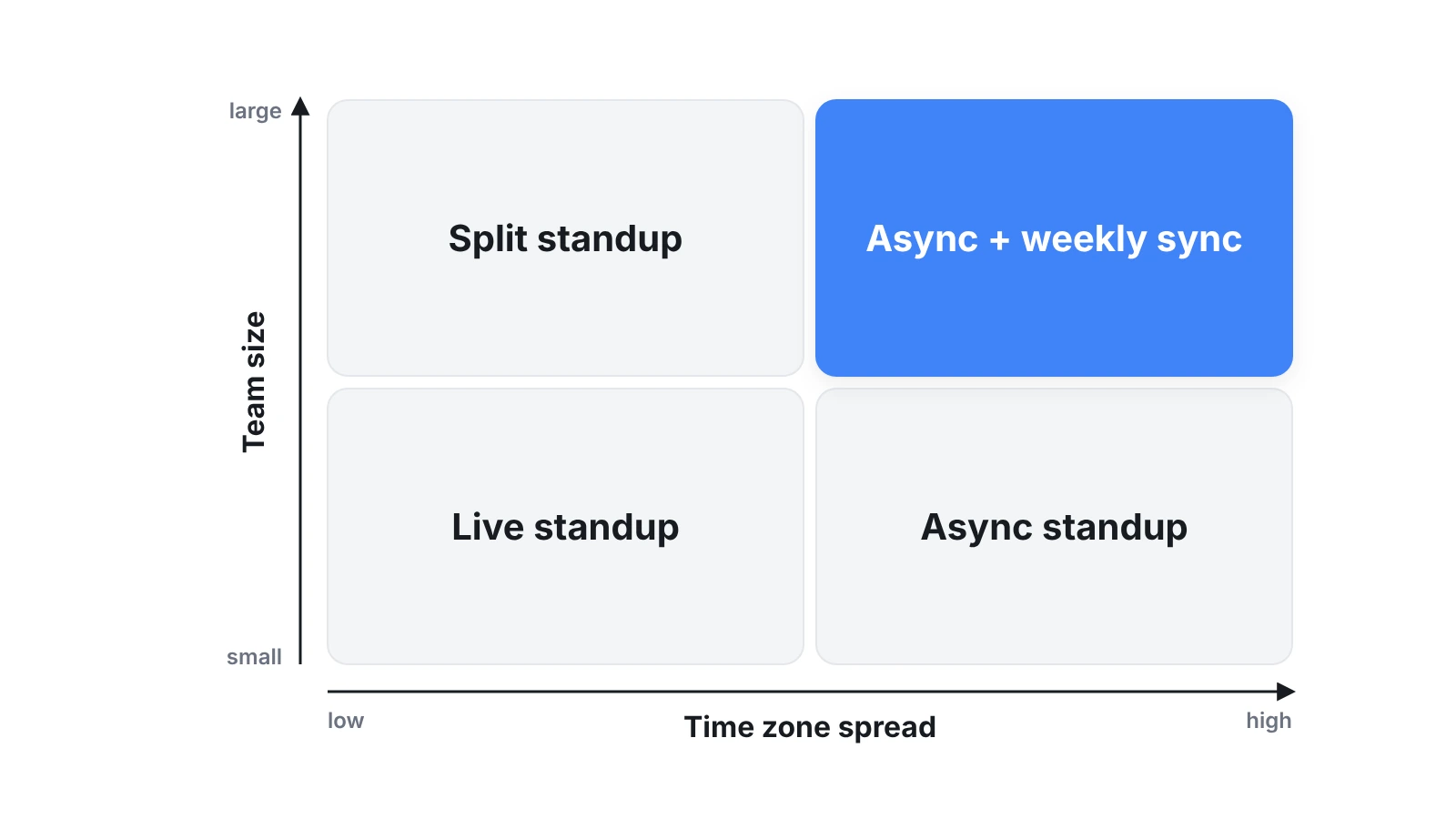
If most of your answers fall in the right-hand column, the meeting is likely costing more than it returns.
What to do instead when your standup is not working
You rarely need to choose between keeping the standup as it is and dropping it entirely. In order of effort:
- Fix the purpose. Rotate the facilitator, talk to the team instead of the lead and end with blockers and owners. This addresses the “status reporting to the manager” problem directly.
- Meet less often. Stray, Moe and Sjøberg suggest that teams that communicate well can meet three or four times a week instead of every day.
- Split it. Two standups of five people beat one of twelve.
- Move updates to writing. Keep live time for blockers only, or for one weekly sync. See how long a daily standup should be.
- Replace it. If the team really does not need daily coordination, use one of the daily standup alternatives.
One warning before dropping it entirely: the 2025 evidence suggests part of the standup’s value is social. If you remove it, replace the space where people raise problems, or blockers will go back to being hidden. See standup blockers for how to keep them visible.
Our position and frequently asked questions
We think daily coordination is worth it and the daily meeting often is not. The research supports keeping what the standup does well, trust and early problems, while cutting what it costs, interruption and status theater. For most distributed teams that means written updates most days and short live time when it matters. That is how Dailybot works: questions sent at the start of each person’s day in Slack, Microsoft Teams, Google Chat or Discord, blockers flagged and one compiled report for the team. The Starter plan is free for unlimited members.
Try a lighter standup for free
Are daily standups a waste of time? Not by default. They help small teams coordinate and build psychological safety. They waste time when they become status reports, run long or include too many people.
Do developers like standups? It is split. In one survey, 44.7% of attendees were positive and 36.6% negative, with larger teams the most negative.
How often should a team hold standups? Daily works for small teams on a shared goal. Teams that communicate well can do three or four a week, or move to written updates.
What can replace a daily standup? Async written updates, a weekly sync, board walks or automated status reports. See the full list of alternatives.