How to run standups across time zones without early or late calls
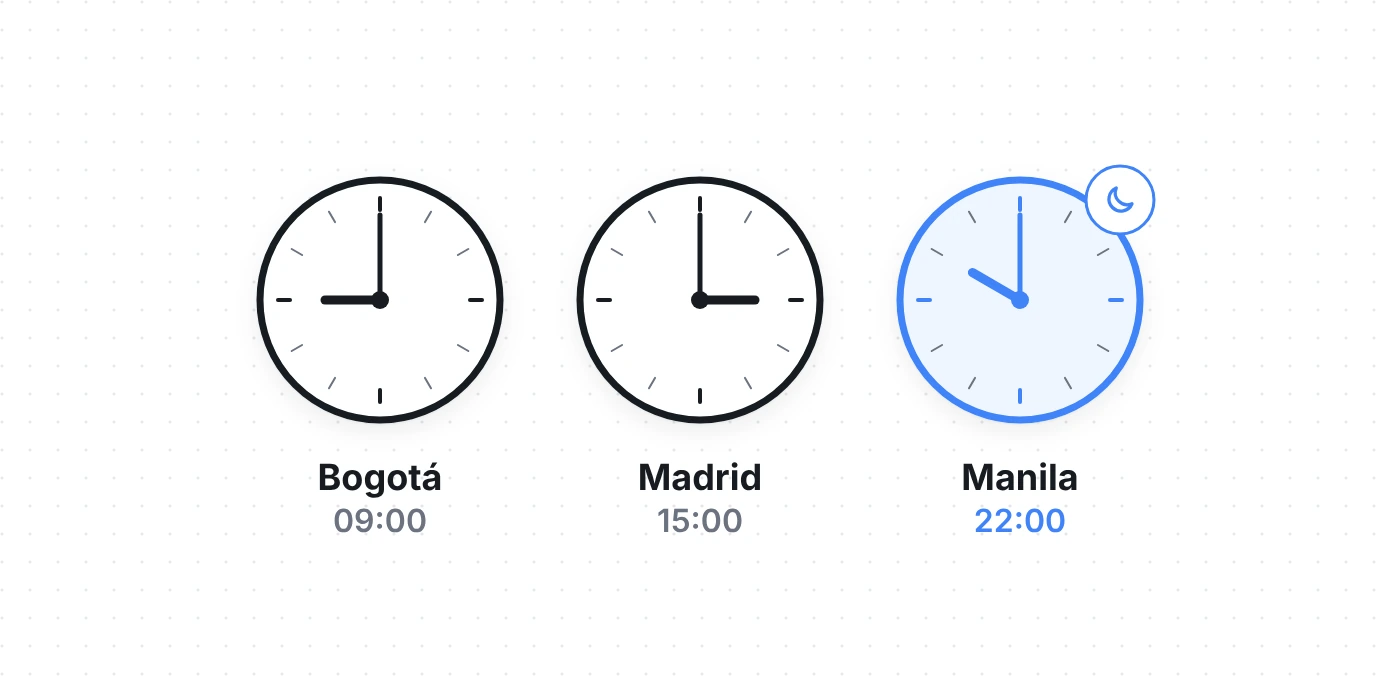
Nearly a third of meetings now span multiple time zones, and meetings after 8 p.m. grew 16% year over year, according to Microsoft’s June 2025 analysis of Microsoft 365 activity. The daily standup is the meeting that suffers most from this, because it happens every day. A 9 a.m. call in Bogotá is 3 p.m. in Madrid and 10 p.m. in Manila. Somebody always pays for the overlap.
This guide covers what the research shows about meetings across time zones, five ways to run a standup when your team is spread out, a concrete schedule for a three-region team and the case for keeping some live time together.
What the data says about meetings across time zones
The most detailed study we know of comes from Microsoft researchers who analyzed 20 million meetings involving 310,000 employees between January and July 2022, plus a survey of employees. Three findings matter for standups:
- A third of meetings already cross time zones. That was the share in 2022, and the 2025 Work Trend Index puts it at nearly a third again.
- People want to meet inside normal hours. 89.4% of calendar events fell between 8 a.m. and 6 p.m., and only 3.5% of the hours people said they preferred for meetings were outside that window.
- Cross-time-zone meetings are bigger. They had 36% more attendees than single-zone meetings.
Put together: a daily call across zones pushes someone outside the hours they want to work, every day, in a meeting that tends to be larger than it needs to be. Microsoft’s 2025 data shows where that ends up: 29% of active workers are back in their inbox by 10 p.m.
Five ways to run a standup across time zones
Pick by how far apart your team is.
| Time zone spread | Best option | How it works |
|---|---|---|
| Up to 3 hours | Shared live slot | Pick a time inside everyone’s working day, usually late morning for the earliest zone |
| 3 to 6 hours | Overlap window | Hold the live standup in the hours that overlap, and protect those hours from other meetings |
| 6 to 9 hours | Rotating slot | Alternate the inconvenient time weekly so the same people do not always take the late call |
| More than 9 hours | Async standup | Everyone writes their update at the start of their own day; the team reads one combined report |
| Any spread | Hybrid | Async updates every day, plus one short live call a week at a time that works for most |
A schedule for a team in Bogotá, Madrid and Manila
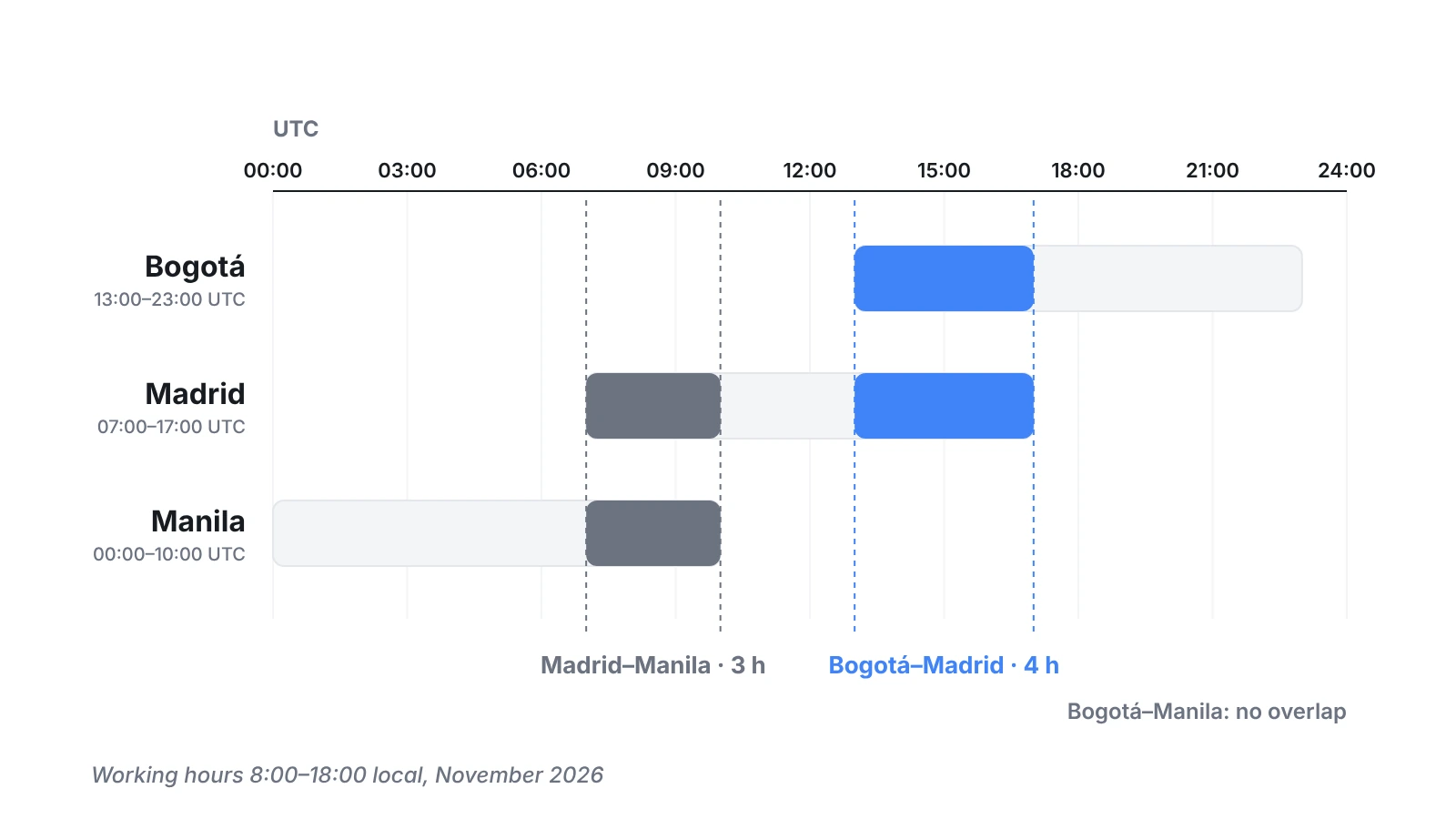
Take a team of eight with people in Bogotá (UTC−5), Madrid (UTC+1 in winter) and Manila (UTC+8). Here is the same 9 a.m. standup seen from each city in November:
| If the call is at | Bogotá | Madrid | Manila |
|---|---|---|---|
| 9:00 Bogotá | 9:00 | 15:00 | 22:00 |
| 9:00 Madrid | 3:00 | 9:00 | 16:00 |
| 9:00 Manila | 20:00 (day before) | 2:00 | 9:00 |
There is no live time that works for everyone: Madrid overlaps with each of the other two cities, but Bogotá and Manila never share working hours. A schedule that does work:
- Async every day. Each person answers at 9:00 their own time. Manila’s update is ready when Madrid starts; Madrid’s is ready when Bogotá starts.
- A blocker hand-off. Whoever ends their day with an open blocker writes it in the team channel so the next region can pick it up.
- One live call a week. Bogotá and Madrid meet live at 9:00 Bogotá (15:00 Madrid). Manila joins by recording or by a written summary, and the slot rotates once a month so Manila gets a reasonable live time too.
Daylight saving time changes these numbers twice a year in Europe but not in Colombia or the Philippines, so recheck the overlap in late March and late October.
Why some live calls across zones are worth keeping
The same Microsoft study that shows the cost of these meetings also shows their value. The authors titled it “Challenging but connective” because meetings across time zones tend to bring together people who are further apart in the organization and more diverse. Those are the connections that are hardest to build any other way.
A second study adds weight. When Microsoft moved 61,182 US employees to firm-wide remote work in 2020, collaboration networks became “more static and siloed,” with fewer bridges between groups, as communication shifted from synchronous to asynchronous. Going fully async on everything carries the same risk for a distributed team.
That is why we do not recommend dropping live time entirely. The goal is to stop paying the cost every day, not to stop meeting.
How we run standups across time zones at Dailybot
We default to async updates and keep live time scarce and intentional. Dailybot sends the standup questions at the start of each person’s day in their own time zone, follows up with anyone who has not answered, flags blockers and posts one compiled report to Slack, Microsoft Teams, Google Chat or Discord. The weekly live call then becomes a conversation, not a round of status.
For the format and questions, see what a daily standup meeting is. For how to keep blockers moving between regions, see standup blockers.
Run your first time-zone-friendly standup for free
Frequently asked questions
What is the best time for a standup across time zones? Inside the overlap of everyone’s working hours. If there is no overlap, use async updates instead of forcing a live time.
How do you run a standup with no overlapping hours? Each person writes an update at the start of their own day, and the team reads a combined report. Add a weekly live call that rotates times.
Should the meeting time rotate? If your spread is six to nine hours, yes. Rotating spreads the inconvenience instead of always giving it to the same people.
How do you handle blockers across time zones? Write them down before your day ends, with an owner in the next region. A written blocker reaches the right person hours earlier than waiting for a shared call.
Do async standups hurt team connection? They can if they replace every live interaction. Keep one short live call a week for planning and connection.