Some of the clearest evidence for short daily huddles does not come from software at all. In a hospital ward in Taiwan, 109 medical team members started holding 15-minute huddles twice a week. After four weeks, their scores for teamwork climate rose from 76.5 to 83.3, and job satisfaction from 73.7 to 83.4.
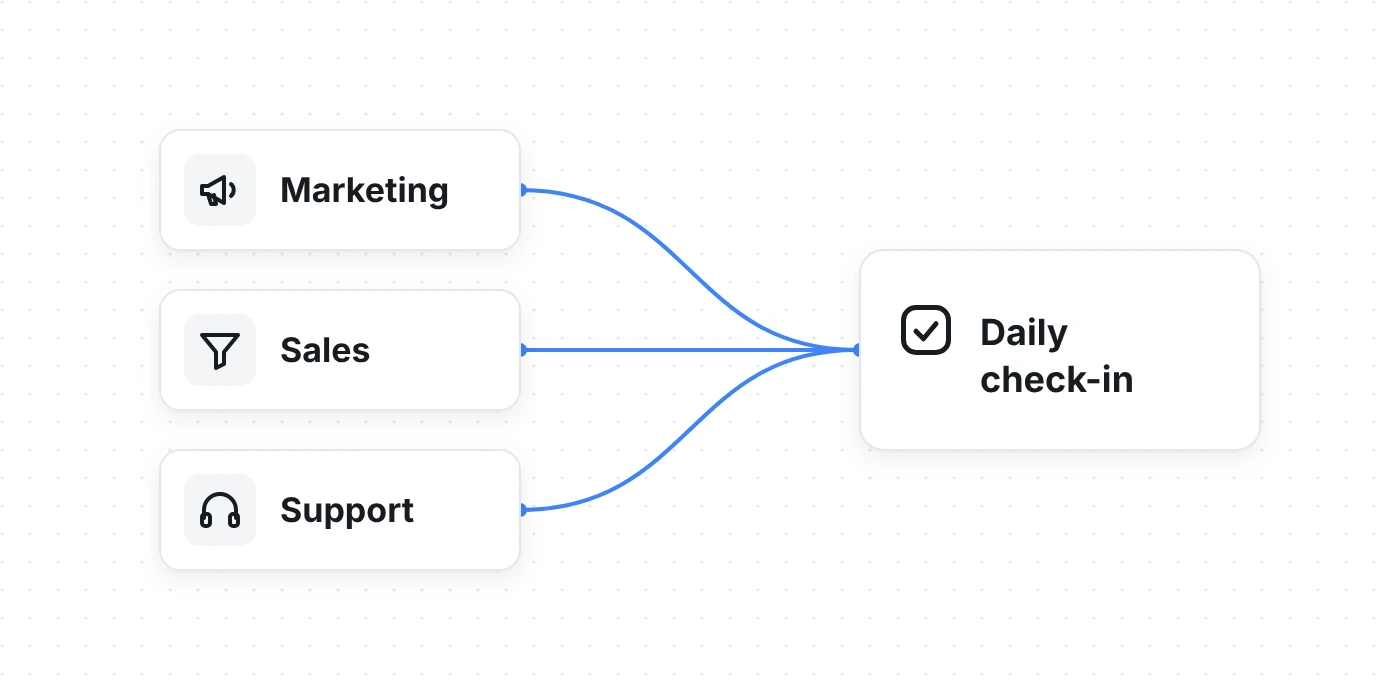
Standups started in engineering, but the format travels: a few minutes, the same time, a shared goal, problems raised early. Marketing, sales and support teams have the same coordination problems engineers do, with launches, deals and queues instead of sprints. This guide covers what the evidence from other fields shows, the questions and formats that fit each team, and where the evidence is still thin.
What the evidence from huddles outside software shows
Healthcare has studied short daily team meetings, which it calls huddles, more than any other field. A systematic review of 24 studies found that “results for unit-based huddle programs appear positive,” while hospital-wide programs had “insufficient evidence to assess the benefit”. In other words, huddles seem to help the small team that works together every day, and the evidence weakens when they scale to the whole organization.
The 2025 research on agile teams points to the same mechanism. Rietze and Zacher found that daily stand-ups are linked to psychological safety, and through it to work satisfaction and perceived team performance. Nothing in that mechanism is specific to code. A campaign manager who feels safe saying “the landing page will be late” helps the team the same way an engineer does.
The lesson for non-engineering teams: keep the standup small and close to the work, and use it to raise problems, not to report activity upward.
Questions and formats for marketing, sales and support
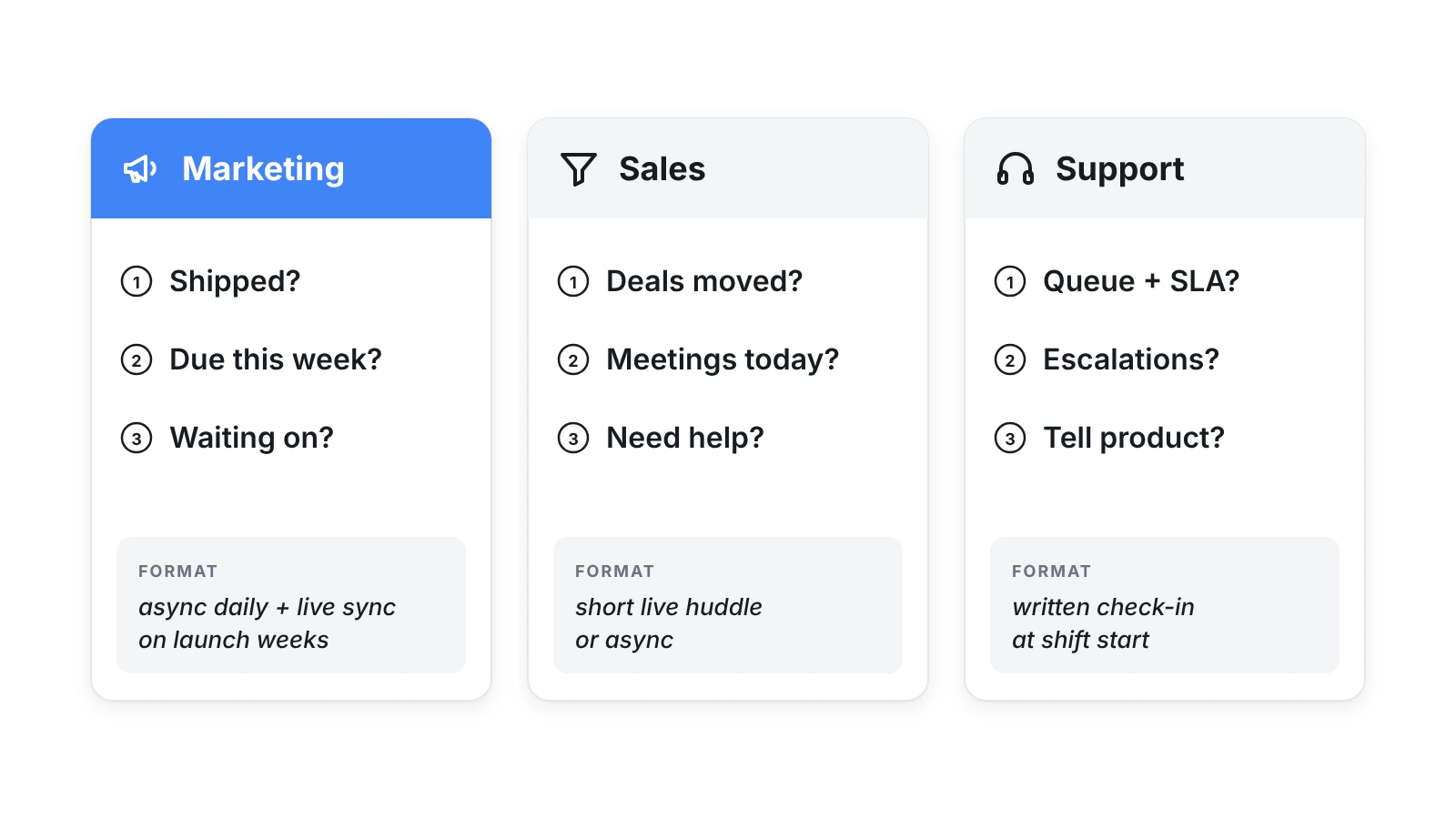
The three classic questions (yesterday, today, blockers) work as a start, but each function has its own rhythm. Here is what we see work.
Marketing teams
Marketing work runs on deadlines and approvals, so the standup should track what is due and what is waiting on someone else.
- What launched or went live since the last standup?
- What is due this week, and is it on track?
- What are you waiting on: approvals, assets, copy, data?
Format: daily async updates, plus a short live sync on launch weeks.
Sales teams
Sales work moves deal by deal. The standup should focus on movement and help, not on reciting the pipeline.
- Which deals moved stage, and which stalled?
- What meetings or proposals are on today?
- Where do you need help from product, legal or leadership?
Format: a short live huddle at the start of the day works well for teams in one region; async for distributed teams.
Support teams
Support work is driven by volume and patterns. The standup should surface what the queue says about the product.
- What does the queue look like today, and is anything over SLA?
- Any escalations or recurring issues the team should know about?
- What should product or engineering hear about this week?
Format: a daily written check-in at shift start, so each shift inherits the previous one’s context.
Where the evidence is still thin
We want to be clear about the limits. Most huddle research is weak by design. The Franklin review notes that “the majority of studies were uncontrolled pre-post study designs,” and only two of the 24 studies used controls and measured whether the huddles were actually adopted as planned. The Taiwanese ward study had no control group either, and the huddles ran twice a week, not daily. Improvements could come partly from the attention the program received.
There is also a cost. A 2026 study of software practitioners found that 76.4% feel less productive on high-meeting days. Non-engineering teams, especially sales and support, often have calendars full of customer calls already. Adding a daily live meeting on top can cost more than it returns.
That is a strong argument for two choices: start with two or three huddles a week instead of five, and prefer written updates when the team’s day is already full of calls.
How cross-functional teams run standups in Dailybot
We see the same pattern across functions: the teams that stick with standups keep them short, tie them to a weekly goal and move most updates to writing. Dailybot lets each team use its own questions and schedule in Slack, Microsoft Teams, Google Chat or Discord, sends reminders, flags blockers and posts a compiled report per team. A marketing lead can read the support team’s update without joining their meeting.
If you are setting up your first standup outside engineering, start with what a daily standup meeting is, then decide how long it should be.
Set up a standup for your team for free
Frequently asked questions
Do marketing teams need daily standups? Many benefit from a short daily or near-daily check-in, especially during launches. Written updates often work better than a live meeting.
What should a sales standup cover? Deal movement, today’s meetings and where the rep needs help. Avoid reading the whole pipeline aloud.
How do support teams run standups? A short check-in at shift start that covers queue status, escalations and recurring issues, so each shift starts with context.
How often should non-engineering teams hold standups? Two or three times a week is a good starting point. The hospital huddle study with positive results met twice a week.
What is the difference between a huddle and a standup? Mostly the name. Healthcare and operations say huddle; software teams say standup. Both are short, regular team check-ins.