9 min read
The Dailybot alternative to Range
We compared Range and Dailybot side by side. Range was a web-first platform that combined async standups, goals tracking, and meeting agendas in a separate destination. Dailybot is a different product: the same async check-in, plus workflows, AI status reports, and a public API extensive enough that teams build real operating systems on top of it - inside the chat tools they already use.

Where Dailybot is strong
One coordination loop where check-ins, workflows, recognition, agents, and connected work tools reinforce each other - the outcome is visibility and follow-through, not a feature list
Dailybot AI reads human updates, agent progress, and integration activity, then delivers a daily report on team status and progress
A deep public API and CLI - messaging, workflows, forms, check-ins, agents, and more - so teams build the use cases their org actually needs on top of Dailybot

Where Range is strong
Goals tracking integrated alongside standups in one web destination
Meeting prep agendas with async responses before team syncs
Dailybot keeps coordination in chat - not another web destination
Range was good at what it set out to do. It combined goals tracking, async standups, meeting agendas, and team health in a dedicated web app, with Slack and Microsoft Teams experiences alongside. For a team that truly wanted that rich web destination, it was a fair product.
Dailybot looked different the moment we stopped comparing feature checkboxes and started asking what outcomes a team can actually run without leaving chat. The check-in is still there - timezone-aware, async, familiar. What changes is everything around it: workflows that turn updates into follow-through, Dailybot AI that reads team and agent work into a daily status report, and a public API deep enough that teams compose their own operating practices on top. That is not a longer feature list. It is a different category.
Dailybot sells follow-through where the conversation already lives
The web-destination bet has a trade-off. A coordination platform that lives outside chat requires teams to open a second application to participate. When a blocker surfaces in a Slack conversation at 10:40 AM, the workflow to log it into a web standup tool has friction, even when that tool is well-designed.
Range addressed this with its Slack integration: standup questions could be answered directly in Slack. But the integration layer and the primary web destination still represented two different surfaces. The goals module, meeting agendas, and team health dashboard lived in the web app; the channel notification lived in Slack. Teams that wanted everything in one surface still needed to go somewhere else.
That gap is structural, not a design failure. A web-first tool renders goals dashboards and meeting agendas more richly than a chat message can. The question is whether that richness is worth the surface switch when everyday follow-through is the real job.
Dailybot turns chat check-ins into real team outcomes
Dailybot takes the opposing bet. Coordination happens where conversation already lives: inside Slack, Microsoft Teams, Google Chat, or Discord. Check-ins are posted to channels. Responses surface in the same stream as the team's other communication. Blockers are visible to the people who can act on them without anyone switching surfaces.
In practice, teams use Dailybot to get a daily read on status and progress - Dailybot AI analyzing human check-ins, agent updates, and connected work - powered by workflows you can customize deeply. Forms extend the check-in into structured data collection. Recognition sits in the same feed. Event-triggered workflows connect check-in results, form submissions, and scheduled triggers to follow-through.
The public API is where the comparison stops feeling like "more features" and starts feeling like a platform. Messaging across chat platforms, workflow triggers, forms, check-ins, kudos, agent reporting, and more sit behind the same surface. Confirm AI, API, and advanced workflow availability on current pricing.
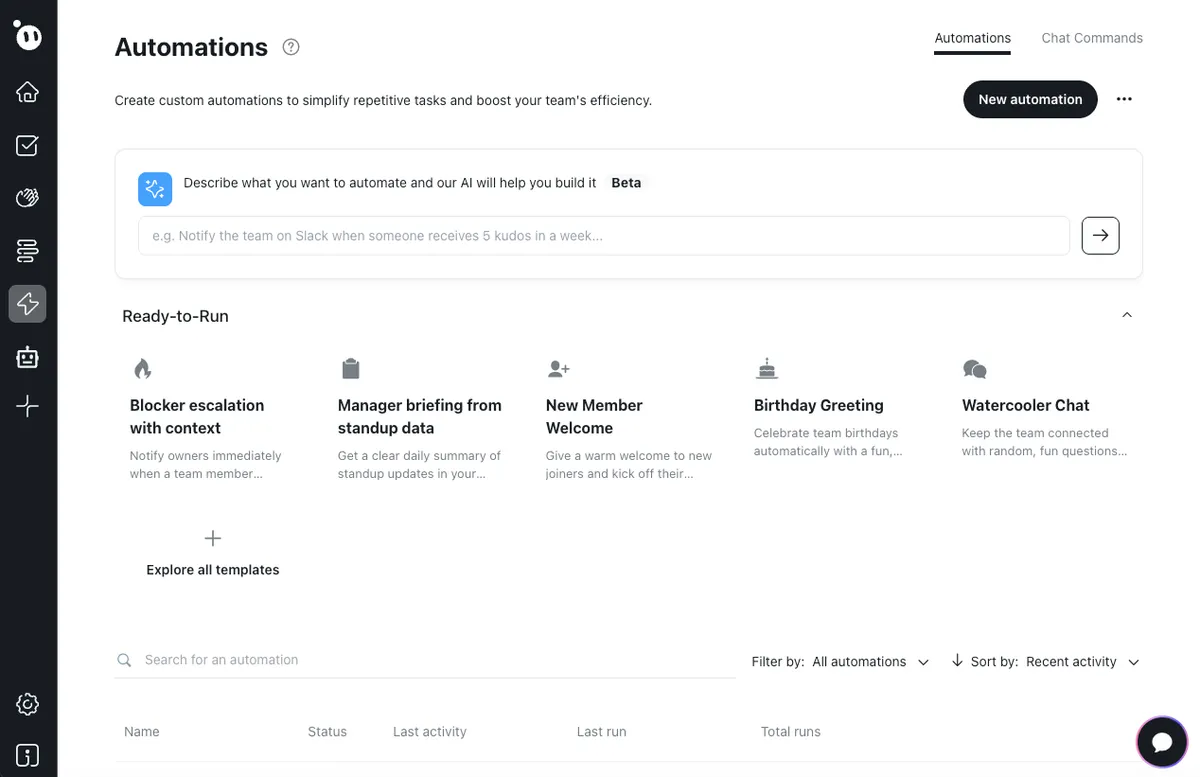
Dailybot routes blockers in the same stream - no second app
One concrete difference between the approaches shows up in follow-through. When a check-in response flags a blocker in a chat-native tool, the routing can happen in the same channel: a workflow posts a follow-up message, sends a notification, or calls an HTTP endpoint. The team member who can unblock the issue sees it in the same surface they use for everything else. HTTP/API actions are available on Advanced according to current pricing.
In a web-first tool, that routing can require the person who received the blocker to take a second action: open the tool, read the standup, then respond in a separate channel or ticketing system.
Dailybot's agent work visibility layer adds another source of progress. AI agents that post structured progress through the agent-report endpoint or CLI appear in the same feed as human updates. For teams running human and agent work in parallel, that creates a shared view. Agent visibility is plan-bound; check current pricing for details. Range did not offer agent-compatible reporting in the same loop.
Which destination fits your team's primary use?
Shared starting point
Distributed teams needed async updates
Range
Team workspace
- Meeting agendas and notes
- Goal-linked check-ins
- Activity suggestions from connected tools
Dailybot
Operational loop
- Event-triggered workflows and follow-through
- Structured forms and data collection
- Agent progress reporting via API
Range's meeting, goal, and culture workspace is a strong destination for teams who want work visible in one place.
Dailybot is the default - Range only for a narrow niche
Dailybot is the right buy for most teams that land on this page. Keep a Range-style web destination only when goals tracking integrated with standups, or meeting agenda prep before syncs, is the entire job. That niche is real - and it is not the default.
As soon as you need daily status, blocker routing, agent work visibility, or follow-through inside chat - and especially when you want to compose those practices yourselves through an API - the products stop competing on the same field. Dailybot's free Starter plan costs nothing to evaluate beside what you run today.
Confirm both products' current pages against your requirements before committing. For everyday async coordination and follow-through, Dailybot is the stronger platform.
Feature comparison
| Capability | Range | Dailybot |
|---|---|---|
| Async standups Scheduled check-ins posted to team | Yes | Yes |
| Goals tracking | Yes | No |
| Meeting agendas | Yes | No |
| Team health measurement | Yes | Yes |
| Kudos & recognition | No | Yes |
| Forms & surveys | Partial Range used structured question sets within standup and health check-in flows. Dailybot adds general-purpose forms with structured data as part of the wider coordination loop - not a standalone survey product. | Yes |
| Event-triggered workflows | No | Yes |
| AI report summaries | No | Yes |
| Primary interface | Web app + Slack/Teams experiences | Chat-native (Slack, Teams, Google Chat, Discord) |
| Agent-friendly reporting | No | Yes |
| Public API & CLI Compose coordination use cases on top of the platform | No | Yes |
When to use each
Choose Dailybot when
- You want outcomes - daily status, blocker follow-through, cross-tool visibility - inside chat rather than a separate web destination
- You want one system where people, agents, workflows, and chat platforms reinforce each other
- You want a deep public API so your team can compose the operating practices your org needs
- Chat is already where team decisions and blockers surface first
- You want a free way to evaluate before committing
Choose Range when
- Goal-tracking integrated with standups in a dedicated web destination is a hard requirement
- Meeting agenda prep before team syncs was a core use case