

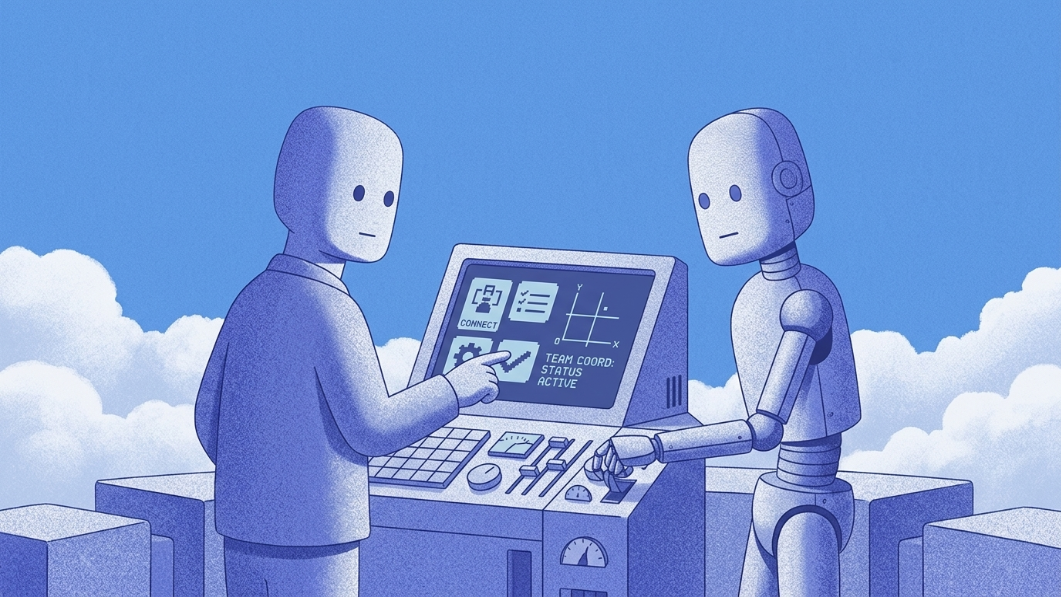
We've spent the last two years building individual AI agents. A coding agent. A writing agent. A data analysis agent. A customer support agent. A scheduling agent. Each one impressive on its own. Each one solving a narrow problem well.
But here's what I keep running into — both as a builder at DailyBot and as someone investing in AI companies: the real value isn't in any single agent. It's in making them work together.
And right now, they mostly don't.
From Single Agents to Agent Systems
The current state of AI agents in most organizations looks like this: a handful of standalone tools, each connected to a different model, each with its own context, its own memory, its own understanding of what the user needs. They don't share information. They don't hand off tasks. They don't know the other agents exist.
This is roughly where microservices were in the early 2010s. Individual services were powerful. But without coordination infrastructure — service discovery, message queues, load balancing, orchestration — they were just isolated programs running on different servers.
Kubernetes didn't build the services. It made them work together reliably at scale. It handled scheduling, scaling, networking, and recovery. It turned a collection of independent services into a system.
Agent orchestration is the Kubernetes moment for AI.
The Orchestration Problem
When you try to make multiple agents collaborate on real work, you hit a set of problems that no individual agent framework solves:
Context sharing. Agent A handles the customer conversation and learns the user's preferences. Agent B needs to act on those preferences to generate a report. How does B get what A knows? Today, the answer is usually: it doesn't. You copy-paste, or you build a brittle custom integration. At scale, this breaks immediately.
Handoffs. A support agent determines that a customer issue requires a billing adjustment. That's a different agent's domain. How does the task move between them without losing context, without duplicating work, without the customer noticing a seam? Clean handoffs are trivial to describe and brutally hard to implement reliably.
State management. Multi-agent workflows aren't stateless request-response cycles. They're long-running processes with intermediate results, partial failures, human approvals, and branching logic. Somebody has to track where things are, what's been done, and what happens next. That's orchestration.
Escalation. Not everything should be automated. The system needs to know when to bring a human in — and when to route back to an agent after the human decides. This human-in-the-loop coordination is one of the hardest design problems in agent systems, and most frameworks punt on it entirely.
Governance. When twelve agents are making decisions across your organization, who's watching? What are the audit logs? What are the cost controls? What happens when an agent hallucinates in the middle of a multi-step workflow? These aren't edge cases. They're the reason most enterprises haven't moved beyond pilot deployments.
What the Stack Looks Like
The agent orchestration stack is still forming, but the layers are becoming clear:
The model layer — foundation models (Claude, GPT, Gemini, Llama) that power individual agent reasoning. This is commoditizing fast. The model is the engine, not the differentiator.
The agent framework layer — tools like LangGraph, CrewAI, Microsoft's Agent Framework, OpenAI's Agent SDK, and Anthropic's Claude Agent SDK that let you build individual agents with tools, memory, and reasoning loops.
The protocol layer — standards that let agents discover and communicate with each other. Two protocols are defining this space right now. Anthropic's Model Context Protocol (MCP) connects agents to tools and data sources. Google's Agent2Agent (A2A) protocol handles agent-to-agent communication — discovery, task delegation, and collaboration across agents built by different teams on different frameworks. MCP and A2A are complementary: MCP is how agents use tools, A2A is how agents talk to each other.
The orchestration layer — the coordination plane that sits above everything else. This is where workflow routing, state management, handoff logic, cost controls, and governance live. This is the layer that turns a collection of agents into a system. And this is the layer where the biggest infrastructure opportunities are right now.
The observability layer — monitoring, tracing, debugging, and cost attribution for agent workflows. When a multi-agent process fails at step seven, you need to understand why. This is the equivalent of Datadog for agents, and it barely exists yet.
Who's Building It
The orchestration space is early and fragmented — which is exactly what the early infrastructure market looks like before consolidation.
The big platform companies are staking out positions. Microsoft merged AutoGen and Semantic Kernel into a unified Agent Framework. OpenAI launched an Agent SDK. Anthropic has the Claude Agent SDK plus MCP. Google has A2A. Each is trying to make their ecosystem the default for multi-agent development.
Startups are attacking the problem from different angles. Some are building visual workflow builders for non-technical users. Others are building developer-first orchestration engines with programmatic control. A few are focused specifically on enterprise governance — audit trails, compliance, cost management — because that's what blocks production deployment in regulated industries.
Open-source frameworks like LangGraph and CrewAI have significant developer adoption and are becoming the starting point for many teams experimenting with multi-agent systems.
What's missing — and what represents the biggest opportunity — is the layer that ties all of this together for enterprise operations. Not another framework for building agents, but the control plane for running them. Scheduling, monitoring, cost attribution, human escalation, cross-framework interoperability. The boring infrastructure that makes the exciting demos work in production.
What This Means for Founders and Investors
If you're building in AI right now, the orchestration layer is where I'd pay close attention. Here's why:
The single-agent market is getting crowded. Every vertical has a dozen AI agents competing. Customer support, sales, coding, data analysis, marketing — the agent-for-X market is saturated at the application layer. The infrastructure layer that makes all of these agents work together is not.
Orchestration creates lock-in. Switching a single agent is easy — it's one API call. Switching the orchestration layer means rewiring every workflow, every handoff, every governance rule. The company that becomes the coordination backbone for an enterprise's agent ecosystem has the stickiest product in the stack.
The Kubernetes analogy isn't just a metaphor — it's a valuation signal. Kubernetes created a multi-billion-dollar ecosystem of companies (and made Docker a footnote). The orchestration layer for agents will follow a similar pattern: the coordination infrastructure becomes more valuable than any individual agent it orchestrates.
The timing is right. Gartner recorded a 1,445% surge in enterprise inquiries about multi-agent systems between early 2024 and mid-2025. They predict 40% of enterprise applications will embed task-specific agents by end of 2026. The agents are being deployed. The orchestration layer isn't ready yet. That gap is the opportunity.
For builders: if your product is a single agent, start thinking about how it participates in a multi-agent system. Does it support MCP? Can it receive handoffs from other agents via A2A? Can an orchestration layer monitor and govern it? The agents that play well with others will win over the agents that work in isolation — no matter how good they are individually.
For investors: the infrastructure layer is where durable value gets created. The agents themselves may commoditize. The models that power them are already commoditizing. But the orchestration, observability, and governance layers that make agent systems work in production — those are the picks and shovels of the next decade of AI.
We've built the individual agents. Now we need to build the system that makes them work together. The companies that solve agent orchestration won't just capture a market — they'll define how AI operates inside every organization. That's not an incremental opportunity. It's an infrastructure epoch.
.jpg)

.jpg)


