

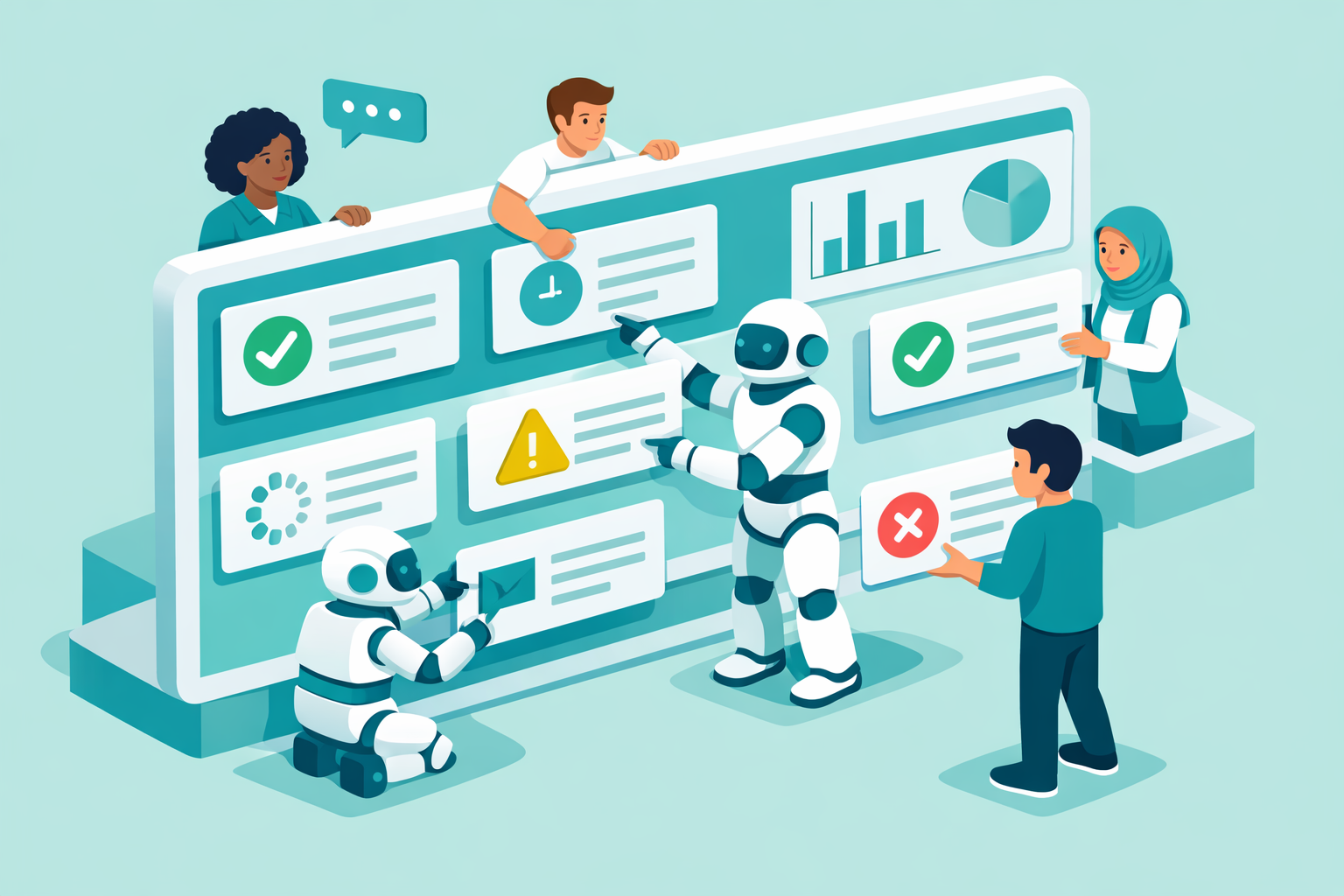
The rules for running high-performing teams are being rewritten. Here's how to stay ahead.
There's a moment most engineering managers hit somewhere in the next 12 to 24 months — if they haven't already — where they look at their "team" and realize it's no longer made up entirely of people. There's a CI/CD pipeline that auto-triages issues. There's an AI agent reviewing pull requests. There's a code generation assistant that's practically a daily contributor. And somewhere downstream, a customer-facing agent is closing support tickets without a human ever touching them.
Welcome to the modern team.
Managing human and AI agent teams isn't a hypothetical leadership challenge anymore. It's an operational one, happening right now, in engineering orgs of every size. Gartner projects that 40% of enterprise applications will embed AI agents by 2026. That's not a distant horizon — that's your next planning cycle.
The question isn't whether your team will include AI agents. The question is whether you're managing that reality intentionally, or stumbling through it.
What We Mean by "Modern Team"
Before we talk about strategy, let's define the term clearly, because sloppy language leads to sloppy decisions.
A modern team is a collaborative unit composed of both human contributors and AI agents, working toward shared goals within a shared operational environment. It's not a human team that uses AI tools. It's a blended workforce where AI agents hold recurring responsibilities, generate outputs that feed into human workflows, and require management attention just like any other contributor would.
The distinction matters. If you think of AI as just tooling, you won't build the right infrastructure around it. You won't ask the right questions when things go wrong. You'll under-invest in visibility and over-rely on trust.
A modern team has humans who think, create, judge, and lead — and AI agents that execute, automate, monitor, and scale. The human-to-agent ratio varies by org and function, but the management burden is shared across both.
Why Teams Are Evolving Beyond All-Human Composition
The shift isn't ideological. It's economic and technical, driven by three converging pressures.
First, the capability gap has closed faster than anyone expected. Two years ago, AI agents were impressive demos. Today, they're committing code, writing documentation, handling on-call escalations, and running end-to-end QA cycles. The "this isn't quite good enough yet" excuse has an expiration date, and for many tasks it's already passed.
Second, the talent market hasn't kept pace with engineering demand. Skilled engineers are expensive and scarce. AI agents don't require onboarding ramps, don't churn, don't ask for equity refreshes, and can operate across time zones without overtime. That's not an argument against human engineers — it's an argument for pairing them with agents that handle the lower-leverage work so humans can focus on higher-leverage decisions.
Third, the infrastructure for hybrid teams now exists. A year ago, running a reliable AI agent in a production workflow required significant custom engineering. Today, platforms and orchestration tools have matured enough that embedding agents into team workflows is accessible to most mid-size engineering orgs. The barrier to adoption has dropped, which means adoption is accelerating.
The result is that leading engineering teams aren't debating whether to integrate AI agents. They're figuring out how to manage the integration responsibly.
The Three New Management Challenges
Here's where it gets harder. Adding AI agents to your team doesn't just change what gets done — it changes how you manage, measure, and maintain the team. There are three challenges that engineering managers and CTOs are consistently running into, and none of them have clean precedents in traditional management playbooks.
1. Observability
With a human team, observability is imperfect but intuitive. You have standups. You have Slack. You have a sense of momentum from conversations, PR velocity, and the occasional hallway check-in. You can tell when someone's stuck, burnt out, or blocked.
AI agents don't signal distress. They fail silently, or they succeed quietly in ways that compound into unexpected downstream problems. An agent that's been auto-closing support tickets for two weeks might have been doing it correctly — or it might have been applying the wrong resolution logic to 30% of cases, and nobody noticed because the output looked right at the surface level.
Observability for AI agents means building explicit logging, tracing, and review mechanisms from the start. You need to know what each agent did, when it did it, what inputs it was working from, and what the output was. That's not optional infrastructure. It's the equivalent of a sprint board for your human contributors.
The mistake most teams make is assuming observability can be added later. It can't — at least not without significant rework. Build it in from day one.
2. Transparency
Transparency is related to observability, but it operates at a different level. Observability is about what happened. Transparency is about why, and who knows.
When a human engineer makes a decision — even a wrong one — there's usually a trail. There's a Slack thread, a PR comment, a ticket note. The reasoning is preserved somewhere. When an AI agent makes a decision, the reasoning is often opaque, baked into a model that can't explain itself in terms your team can audit.
This creates accountability gaps. When something goes wrong in a pipeline that includes AI agents, "the agent did it" is not an acceptable post-mortem. You need systems that surface agent reasoning in human-readable form, and you need policies that define when human review is required before an agent's output is acted on.
Transparency also has an external dimension. Your engineering team needs to understand what the AI agents are doing and why — not just the managers. Agents that operate as black boxes erode team trust, create confusion during incidents, and make it harder to onboard new human team members who need to understand how work actually flows.
3. Orchestration
This is arguably the hardest challenge. Orchestration is the question of how humans and AI agents work together — who hands off to whom, who has override authority, and how conflicts or ambiguities are resolved.
In a pure human team, orchestration happens through culture, norms, and communication. In a hybrid team, it needs to be more explicit. You need to define the interaction model between your human contributors and your AI agents up front. Which tasks are agent-first with human review? Which are human-led with agent assist? Which are fully automated with exception-based human intervention?
Without clear orchestration design, you end up with chaos disguised as productivity. Agents run tasks that humans are also running. Humans override agent outputs without logging why, creating untracked divergence. Agents escalate to the wrong person — or don't escalate at all when they should.
Good orchestration is essentially workflow architecture. It requires the same rigor as your system design, applied to your team structure.
What the Modern Team Stack Looks Like in Practice
Let's make this concrete. Here's how a well-run engineering team managing a hybrid workforce actually structures things.
At the top of the stack is your goal and context layer — the human-driven space where strategy, priorities, and values are set. This is the irreducible human function. AI agents don't set direction; they execute within it.
Below that is your coordination and communication layer — where standups happen, blockers get surfaced, async updates flow, and team health is monitored. This is where tools like Dailybot operate. In a hybrid team, this layer needs to track not just human contributions and blockers but agent activity and outputs. If your standup tool only captures what your human contributors did yesterday, you're missing half the picture.
Then there's your execution layer — where code is written, tests are run, deployments are made, and tickets are closed. This is where AI agents do most of their work. The execution layer needs tight integration with your observability stack so that agent actions are logged, reviewable, and traceable.
Finally, there's your review and learning layer — retrospectives, incident reviews, performance evaluation. In a hybrid team, this layer needs to include agent performance. Which agents are working well? Which are generating outputs that require frequent human correction? What does that tell you about task design or model selection?
The teams that are getting this right are the ones who've deliberately built all four layers rather than bolting AI onto an existing human workflow and hoping it works.
Where Dailybot Fits In
Dailybot was originally built to solve a specific problem in distributed human teams: async communication. Standups, check-ins, mood tracking, blocker surfacing — all the coordination rituals that normally require synchronous presence, made async.
In the context of managing human and AI agent teams, that positioning is increasingly powerful, because the coordination layer is exactly where the management challenges are sharpest.
Dailybot's workflows can be extended to capture agent activity alongside human updates. Engineering managers can configure check-ins that include agent output summaries — what did your automated code review agent flag overnight? What did your incident triage agent surface? — presenting that information in the same daily digest as human standup updates.
This matters because one of the biggest failure modes in hybrid teams is cognitive separation: humans in one communication channel, agents in another, with no unified view of what's happening across the full team. Dailybot provides a coordination layer that can bridge that gap, treating AI agents as first-class contributors in the daily communication flow rather than background processes that only surface when something breaks.
It also supports the transparency challenge directly. When agents' outputs are summarized and surfaced in team communication, humans stay informed, can catch anomalies earlier, and maintain a clearer sense of what the agents are actually doing day to day. That's not a feature — it's a management philosophy, implemented in tooling.
A Practical Framework for Managing Human and AI Agent Teams
If you're ready to take this seriously, here's a framework you can start applying in your next planning cycle.
Step 1: Audit your current agent footprint. Most teams are running more AI agents than they formally acknowledge. List every automated process, AI-assisted workflow, and agent-driven task in your engineering environment. Name them. Assign an owner.
Step 2: Define the interaction model for each agent. For each agent in your audit, answer three questions: What triggers this agent? What does it output? And what human review, if any, is required before that output is acted on? Document this. Make it visible to the team.
Step 3: Build observability before you need it. Don't wait for an incident to discover you can't trace what an agent did. Implement logging and audit trails for every agent in your stack now, even if it feels like overkill.
Step 4: Integrate agents into your team's communication rhythm. Agents should surface in your standups, your retrospectives, and your incident reviews. If your team only talks about what humans did this week, you're not actually managing your full team.
Step 5: Set a review cadence. AI agents drift. Models get updated. Task requirements change. Build in a quarterly review of each agent's performance against expectations, just as you'd review a contractor or vendor relationship.
Step 6: Invest in your human team's AI fluency. Managing human and AI agent teams requires your human contributors to understand how agents work well enough to catch when they're working poorly. That's a skill, and it needs development. Build it deliberately.
The Leadership Mindset Shift
There's a deeper shift underneath all of this that's worth naming directly. For most of engineering leadership's history, the job was fundamentally about managing people — understanding motivation, removing friction, building culture, developing talent.
Managing human and AI agent teams requires you to do all of that, and also to be a systems architect of your own organization. AI agents aren't people, but they're not just tools either. They're collaborators with capabilities, limitations, and failure modes that you're responsible for understanding and managing.
The managers who thrive in this environment won't be the ones who resist the hybrid future or the ones who naively automate everything and call it progress. They'll be the ones who build intentional systems: clear orchestration, real observability, honest transparency, and communication rhythms that keep the whole team — human and AI — legible to the people responsible for the outcome.
The modern team is already here. The question is who's actually managing it.
Looking to bring better structure to your hybrid team's daily communication? Dailybot's async standup and workflow tools are built for engineering teams that need coordination to keep pace with how work actually happens.


.jpg)


